

Advances in circular biorefinery processes towards organic acids from crude glycerol by microbial cell factories (https://doi.org/10.1016/j.psep.2025.107748)
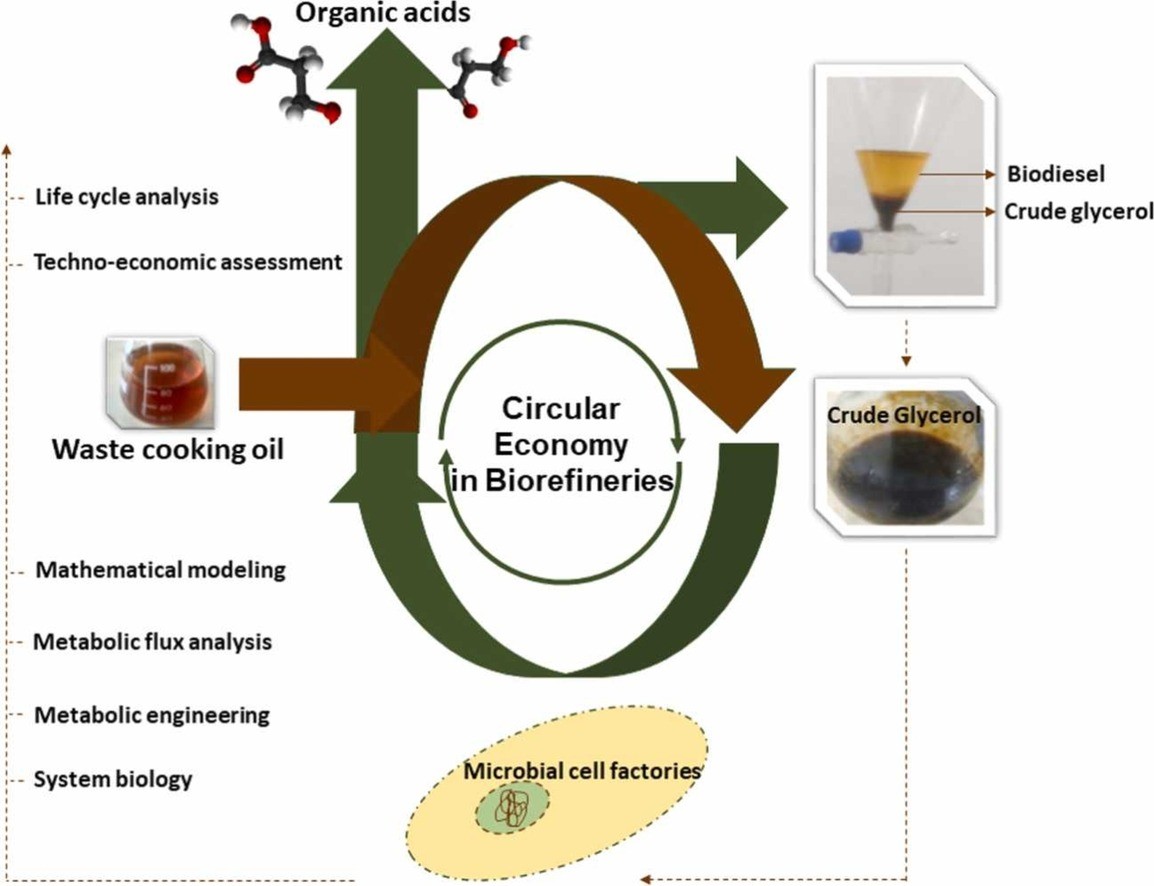
Organic acids are high-value chemicals traditionally produced through petrochemical routes or by microbial cell factories (MCFs) utilizing diverse carbon substrates. MCFs consist of engineered microorganisms capable of converting various feedstocks into industrially important value-added compounds. Recently, the use of oil-derived waste crude glycerol (CG) as an alternative carbon source for large-scale organic acid production has gained significant attention as a sustainable substitute for conventional chemical synthesis. This work discusses the major organic acids generated from CG using microbial platforms and evaluates these processes through life cycle assessment (LCA) and techno-economic analysis (TEA) within a cradle-to-gate circular economy framework. Among different microorganisms, Yarrowia lipolytica demonstrates remarkable versatility in producing a wide range of organic acids from CG at the bioreactor scale. Due to the inhibitory nature of CG, fermentation strategies such as fed-batch and repeated-batch operations are commonly applied to improve substrate utilization and product formation. Furthermore, advances in metabolic engineering, metabolic flux analysis, systems biology, and computational modeling have significantly enhanced productivity, yield, and process efficiency under environmentally friendly and energy-efficient conditions. Overall, crude glycerol represents a cost-effective renewable feedstock with strong potential for organic acid production in future circular biorefinery systems at pilot-scale operations.
- Research Area :Chemical Sciences & Technology Division (CSTD)