

Multifunctional materials for optoelectronic applications
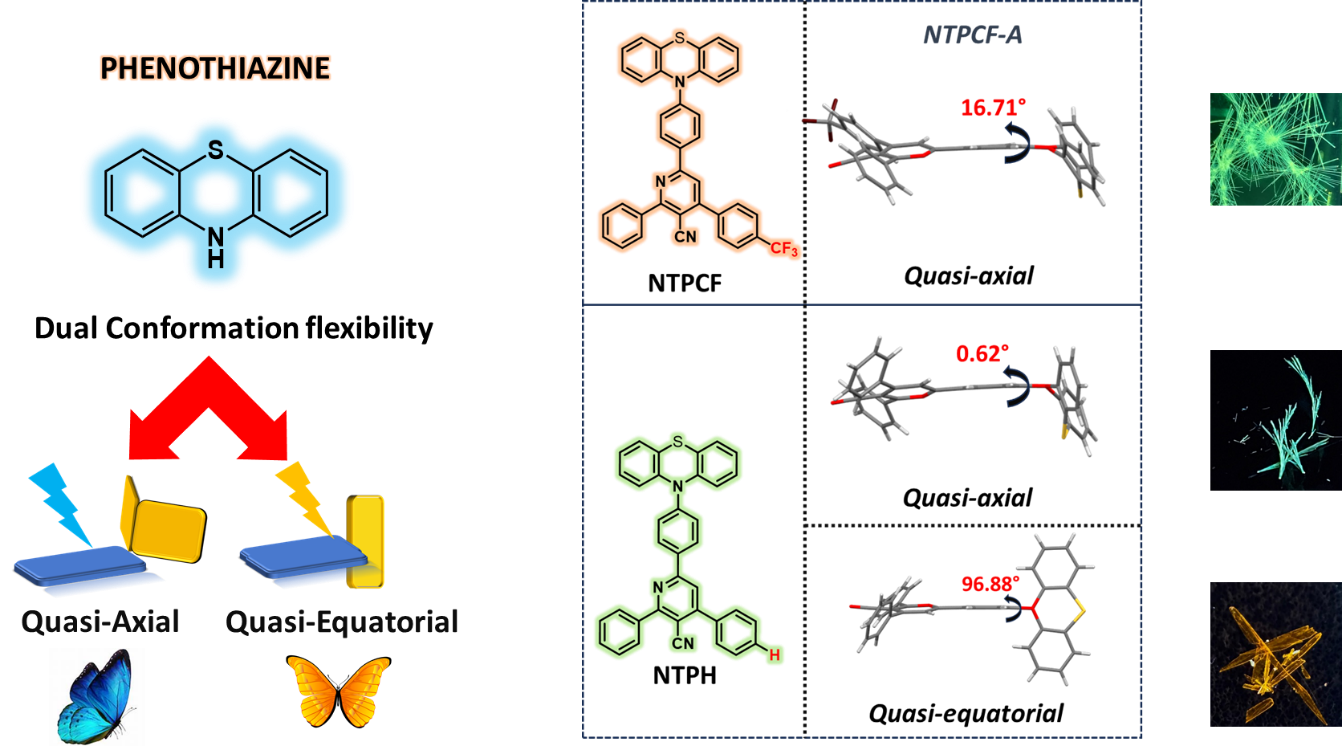
Multifunctional organic materials capable of exhibiting fluorescence, thermally activated delayed fluorescence (TADF), mechanochromism, and stimuli-responsive optical behavior are emerging as key components for next-generation organic electronic and optoelectronic devices. These materials offer unique advantages such as structural tunability, solution processability, lightweight design, and compatibility with flexible electronics, making them highly attractive for applications in OLEDs, sensors, smart displays, security devices, and adaptive photonic systems.
At the molecular level, donor-π-acceptor (D-π-A) architectures provide an effective strategy to engineer multifunctionality by controlling intramolecular charge transfer and excited-state dynamics. In particular, phenothiazine-based systems serve as versatile electron-donating frameworks due to their conformational flexibility, enabling multiple emissive pathways within a single molecule. The coexistence of quasi-axial and quasi-equatorial conformers introduces distinct photophysical properties, allowing tunable emission across a broad spectral range.
Recent developments demonstrate that conformationally adaptive phenothiazine derivatives can exhibit switchable fluorescence and TADF emission, governed by small singlet-triplet energy gaps (ΔEST) and low conformational energy barriers. Such dynamic conformational flexibility enables temperature-, pressure-, or mechanically induced modulation of emission properties in the solid state. These materials display pronounced mechanochromic behavior, with reversible or irreversible color changes arising from structural reorganization, making them suitable for anticounterfeiting and stress-sensing applications.
By careful molecular design, these multifunctional emitters achieve:
- Tunable emission from cyan to orange and white light
- Efficient TADF through controlled charge-transfer states
- High optical contrast under mechanical stimuli
- Stable solid-state emission with enhanced device compatibility
Importantly, solution-processed organic light-emitting devices fabricated using these materials demonstrate high luminance and efficient white-light emission, including single-molecule white OLEDs achieved through controlled conformational populations and doping strategies.
Research at CSIR-NIIST focuses on the design, synthesis, and photophysical engineering of multifunctional organic materials for advanced electronic applications. Efforts include developing novel donor-acceptor systems with tailored excited-state properties, understanding structure-property relationships through spectroscopy and theoretical studies, and integrating these materials into OLEDs and stimuli-responsive optoelectronic devices. The ability to combine fluorescence, TADF, and mechanochromism within a single molecular platform enables multi-functional device operation, reducing device complexity while improving efficiency and functionality. These studies contribute toward the development of high-performance, solution-processable organic electronic materials, supporting scalable manufacturing of flexible displays, smart lighting technologies, and advanced photonic devices aligned with future optoelectronic industry needs.
- Research Area :Chemical Sciences & Technology Division (CSTD)