

Organic Electrochromic Materials & Devices
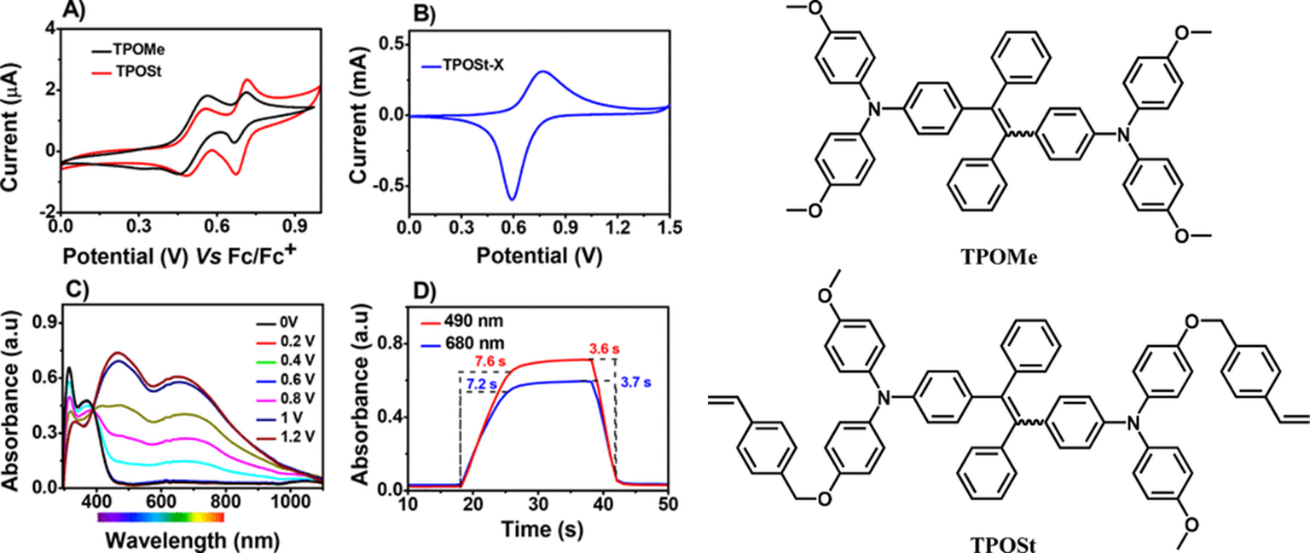
Organic electrochromic (EC) materials are gaining significant attention for next-generation smart windows, low-power displays, adaptive camouflage, and energy-efficient building technologies, owing to their lightweight nature, color tunability, low operating voltage, and compatibility with solution-based fabrication. Among organic systems, triphenylamine- and carbazole-based derivatives have emerged as highly promising electrochromic materials due to their easy synthesis, low oxidation potentials, high charge-carrier mobility, electrochemical stability, and tunable optical responses through molecular design.
A major advancement in this field is the development of cross-linkable small-molecule electrochromic materials, which combine the synthetic precision of small molecules with the robustness of polymeric systems. Cross-linking enables the formation of uniform, solvent-resistant, and mechanically stable electrochromic films, significantly improving device durability and operational stability. Importantly, tuning the degree of cross-linking allows precise control over film morphology, conductivity, ion transport pathways, and switching performance.
Recent studies on donor-π-donor (D-π-D) carbazole-diphenylamine derivatives incorporating thermally cross-linkable styryl groups demonstrate the impact of molecular engineering on EC performance. Molecules containing higher numbers of cross-linkable units form hyper-cross-linked networks, producing rigid and transparent films with enhanced thermal and electrochemical stability. These hyper-cross-linked structures exhibit porous and ordered morphologies that facilitate efficient charge transport and ion diffusion.
Spectroelectrochemical studies show reversible color modulation from transparent/colorless to light yellow and deep blue states, with high optical contrast and excellent coloration efficiency. Increased cross-link density results in:
- Higher coloration efficiency and optical contrast
- Improved open-circuit memory
- Reduced charge-transfer resistance
- Faster ion diffusion and switching kinetics
- Enhanced cycling and environmental stability
Industrial Relevance and Technology Translation
From an industrial perspective, organic electrochromic materials offer strong advantages including low-temperature processing, scalability, compatibility with flexible substrates, and reduced manufacturing costs compared to inorganic EC technologies. These features make them highly attractive for large-area smart windows aimed at reducing building energy consumption by dynamically controlling light and heat transmission.
At CSIR-NIIST, focused efforts are underway to design and develop cross-linkable electrochromic small molecules and scalable device architectures for practical deployment. The team is actively working toward the fabrication of large-area smart window prototypes based on these advanced organic electrochromic materials. By optimizing molecular structure, cross-link density, and film-processing strategies, the research aims to achieve high optical contrast, long-term operational stability, and industrially viable electrochromic coatings.
This work contributes to the development of indigenous electrochromic technologies aligned with sustainable infrastructure and energy-saving solutions, supporting future commercialization of smart glazing systems for buildings, transportation, and adaptive optoelectronic applications.
- Research Area :Chemical Sciences & Technology Division (CSTD)