

Decoding Elastic, Plastic, and Elastic–Plastic Deformation in Molecular Crystals
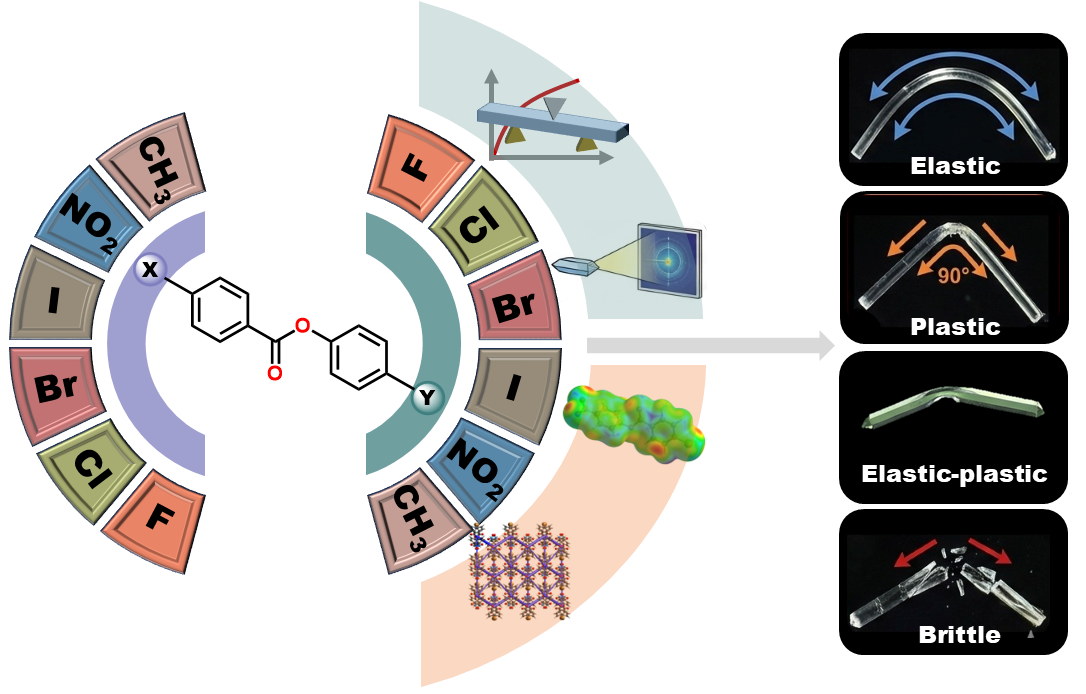
Mechanical flexibility in molecular crystals is crucial for their integration into adaptive and flexible technologies, yet it remains challenging to predict and control. We in our laboratory explore the structure–mechanical properties of crystalline materials that exhibit a range of mechanical responses-elastic, plastic, elastic–plastic, and brittle. By varying the type and position of substituents, we modulated intermolecular interaction hierarchies, packing anisotropy, and deformation pathways. Three-point bending experiments, combined with single-crystal X-ray diffraction (SXRD), molecular electrostatic potential (MESP) analysis, Hirshfeld surface (HS) analysis, surface rugosity, attachment energy calculations, and energy-framework analysis, reveal the structural origins of distinct mechanical behaviors. Elasticity in these crystals is linked to the corrugated packing with balanced, reversible dispersive interactions; plasticity, in contrast, is driven by layered architectures with weak interlayer interfaces and accessible slip planes. Elastic–plastic transitions emerge from a subtle balance between stiff intralayer frameworks and stress-sensitive interlayer contacts. Our study provides a comprehensive and predictive framework for understanding the structure–mechanical relationships in molecular crystals and offers robust design principles for engineering organic solids with tailored elastic and plastic properties.
- Research Area :Chemical Sciences & Technology Division (CSTD)