

Development of Organic Hole Transport Materials (HTMs) for High-Efficiency Perovskite Solar Cells
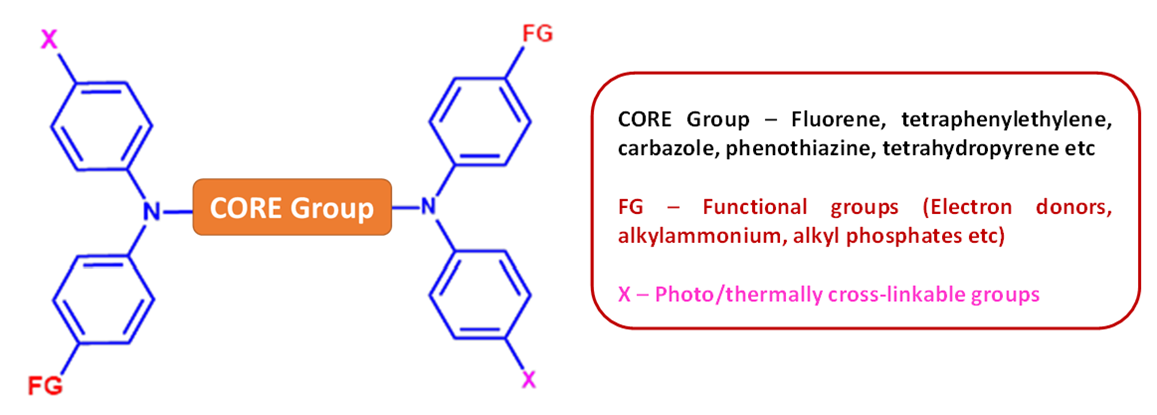
Organic Hole Transport Materials (HTMs) play a decisive role in achieving high-efficiency and stable perovskite solar cells (PSCs), particularly in p-i-n (inverted) device architectures. Efficient HTMs enable selective hole extraction, suppress interfacial recombination, improve open-circuit voltage (Voc), and enhance long-term operational stability, key factors for achieving power conversion efficiencies (PCEs) exceeding 20%.
At CSIR-NIIST, focused efforts are underway to develop cost-effective, solution-processable organic HTMs based on carbazole and triphenylamine derivatives, including both: Self-assembled monolayers (SAM-HTMs) for interface engineering and Cross-linkable small-molecule HTMs for robust and solvent-resistant layers.
The research emphasizes:
- Simple and scalable synthetic routes
- Tunable energy levels for perfect band alignment with state-of-the-art perovskite absorbers
- High hole mobility and excellent film-forming properties
- Thermal, chemical, and photostability
- Compatibility with solution-processed perovskite layers
Comprehensive investigations include organic synthesis, photophysical analysis, electrochemical characterization, stability assessment, thin-film morphology studies, and full PSC device fabrication and evaluation. A growing library of 50+ newly designed HTMs is being developed to systematically optimize structure-property-performance relationships. Importantly, the development of solution-processable HTMs enables low-temperature fabrication routes, making them highly suitable for flexible and large-area PSC modules, thereby accelerating the commercialization of lightweight, cost-effective solar technologies for large-scale deployment. This integrated materials-to-device approach strengthens indigenous capability in advanced photovoltaic materials and supports the development of next-generation high-efficiency, stable, and scalable perovskite solar technologies.
- Research Area :Chemical Sciences & Technology Division (CSTD)