

Chemical Sciences and Technology - R&D Programmes
R&D Programmes
1. Development of Organic Hole Transport Materials (HTMs) for High-Efficiency Perovskite Solar Cells: Organic Hole Transport Materials (HTMs) play a decisive role in achieving high-
efficiency and stable perovskite solar cells (PSCs), particularly in p-i-n (inverted) device architectures. Efficient HTMs enable selective hole extraction, suppress interfacial recombination, improve open-circuit voltage (V oc ), and enhance long-term operational stability, key factors for achieving power conversion efficiencies (PCEs)exceeding 20%.
At CSIR-NIIST, focused efforts are underway to develop cost-effective, solution- processable organic HTMs based on carbazole and triphenylamine derivatives, including both: Self-assembled monolayers (SAM-HTMs) for interface engineering and Cross-linkable small-molecule HTMs for robust and solvent-resistant layers.
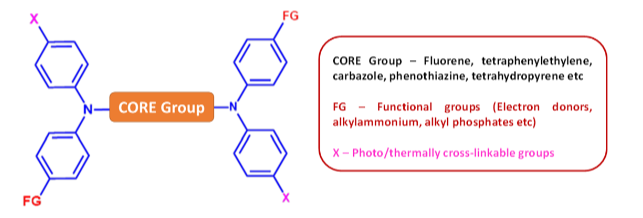
The research emphasizes:
Simple and scalable synthetic routes
Tunable energy levels for perfect band alignment with state-of-the-art
perovskite absorbers
High hole mobility and excellent film-forming properties
Thermal, chemical, and photostability
Compatibility with solution-processed perovskite layers Comprehensive investigations include organic synthesis, photophysical analysis, electrochemical characterization, stability assessment, thin-film morphology studies, and full PSC device fabrication and evaluation. A growing library of 50+ newly designed HTMs is being developed to systematically optimize structure-property- performance relationships. Importantly, the development of solution-processable HTMs enables low-temperature fabrication routes, making them highly suitable for flexible and large-area PSC modules, thereby accelerating the commercialization of lightweight, cost-effective solar technologies for large-scale deployment. This integrated materials-to-device approach strengthens indigenous capability in advanced photovoltaic materials and supports the development of next-generation high-efficiency, stable, and scalable perovskite solar technologies.
2. Organic Electrochromic Materials & Devices
Organic electrochromic (EC) materials are gaining significant attention for next- generation smart windows, low-power displays, adaptive camouflage, and energy- efficient building technologies, owing to their lightweight nature, color tunability, low operating voltage, and compatibility with solution-based fabrication. Among organic systems, triphenylamine- and carbazole-based derivatives have emerged as highly promising electrochromic materials due to their easy synthesis, low oxidation potentials, high charge-carrier mobility, electrochemical stability, and tunable optical
responses through molecular design. A major advancement in this field is the development of cross-linkable small-
molecule electrochromic materials, which combine the synthetic precision of small molecules with the robustness of polymeric systems. Cross-linking enables the formation of uniform, solvent-resistant, and mechanically stable electrochromic films, significantly improving device durability and operational stability. Importantly, tuning the degree of cross-linking allows precise control over film morphology, conductivity, ion transport pathways, and switching performance. Recent studies on donor–π–donor (D–π–D) carbazole–diphenylamine derivatives incorporating thermally cross-linkable styryl groups demonstrate the impact of molecular engineering on EC performance. Molecules containing higher numbers of cross-linkable units form hyper-cross-linked networks, producing rigid and transparent films with enhanced thermal and electrochemical stability. These hyper- cross-linked structures exhibit porous and ordered morphologies that facilitate efficient charge transport and ion diffusion.
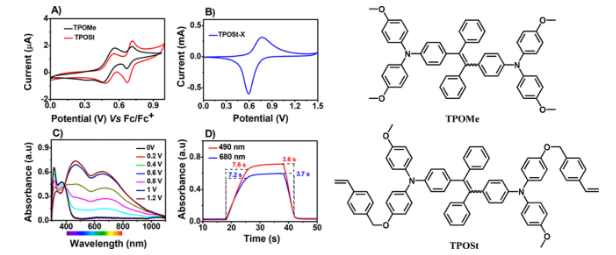
Spectroelectrochemical studies show reversible color modulation from transparent/colorless to light yellow and deep blue states, with high optical contrast and excellent coloration efficiency. Increased cross-link density results in:
• Higher coloration efficiency and optical contrast
• Improved open-circuit memory
• Reduced charge-transfer resistance
• Faster ion diffusion and switching kinetics
• Enhanced cycling and environmental stability
Industrial Relevance and Technology Translation
From an industrial perspective, organic electrochromic materials offer strong advantages including low-temperature processing, scalability, compatibility with flexible substrates, and reduced manufacturing costs compared to inorganic EC technologies. These features make them highly attractive for large-area smart windows aimed at reducing building energy consumption by dynamically controlling light and heat transmission.
At CSIR-NIIST, focused efforts are underway to design and develop cross-linkable electrochromic small molecules and scalable device architectures for practical deployment. The team is actively working toward the fabrication of large-area smart window prototypes based on these advanced organic electrochromic materials. By optimizing molecular structure, cross-link density, and film-processing strategies, the research aims to achieve high optical contrast, long-term operational stability, and industrially viable electrochromic coatings. This work contributes to the development of indigenous electrochromic technologies aligned with sustainable infrastructure and energy-saving solutions, supporting future commercialization of smart glazing systems for buildings, transportation, and adaptive optoelectronic applications.
3. Multifunctional materials for optoelectronic applications
Multifunctional organic materials capable of exhibiting fluorescence, thermally activated delayed fluorescence (TADF), mechanochromism, and stimuli-responsive optical behavior are emerging as key components for next-generation organic electronic and optoelectronic devices. These materials offer unique advantages such as structural tunability, solution processability, lightweight design, and compatibility with flexible electronics, making them highly attractive for applications in OLEDs, sensors, smart displays, security devices, and adaptive photonic systems. At the molecular level, donor–π–acceptor (D–π–A) architectures provide an effective strategy to engineer multifunctionality by controlling intramolecular charge transfer and excited-state dynamics. In particular, phenothiazine-based systems serve as
versatile electron-donating frameworks due to their conformational flexibility, enabling multiple emissive pathways within a single molecule. The coexistence of quasi-axial and quasi-equatorial conformers introduces distinct photophysical
properties, allowing tunable emission across a broad spectral range.
Recent developments demonstrate that conformationally adaptive phenothiazine derivatives can exhibit switchable fluorescence and TADF emission, governed by small singlet-triplet energy gaps (ΔE ST ) and low conformational energy barriers. Such dynamic conformational flexibility enables temperature-, pressure-, or mechanically induced modulation of emission properties in the solid state. These materials display pronounced mechanochromic behavior, with reversible or irreversible color changes arising from structural reorganization, making them suitable for anticounterfeiting and
stress-sensing applications.
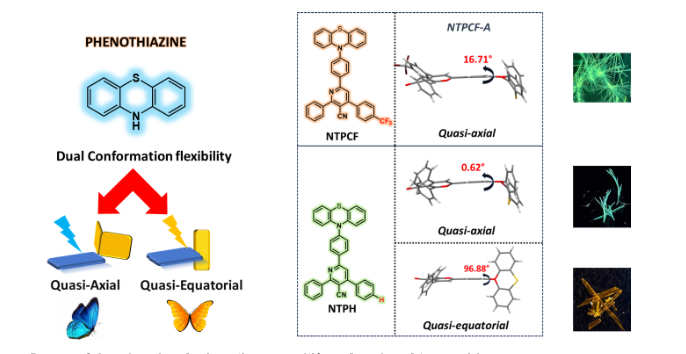
By careful molecular design, these multifunctional emitters achieve:
Tunable emission from cyan to orange and white light
Efficient TADF through controlled charge-transfer states
High optical contrast under mechanical stimuli
Stable solid-state emission with enhanced device compatibility
Importantly, solution-processed organic light-emitting devices fabricated using these materials demonstrate high luminance and efficient white-light emission, including single-molecule white OLEDs achieved through controlled conformational populations and doping strategies. Research at CSIR-NIIST focuses on the design, synthesis, and photophysical engineering of multifunctional organic materials for advanced electronic applications. Efforts include developing novel donor–acceptor systems with tailored excited-state properties, understanding structure–property relationships through spectroscopy and theoretical studies, and integrating these materials into OLEDs and stimuli-
responsive optoelectronic devices. The ability to combine fluorescence, TADF, and mechanochromism within a single molecular platform enables multi-functional device operation, reducing device complexity while improving efficiency and functionality. These studies contribute toward the development of high-performance, solution- processable organic electronic materials, supporting scalable manufacturing of flexible displays, smart lighting technologies, and advanced photonic devices aligned with future optoelectronic industry needs.
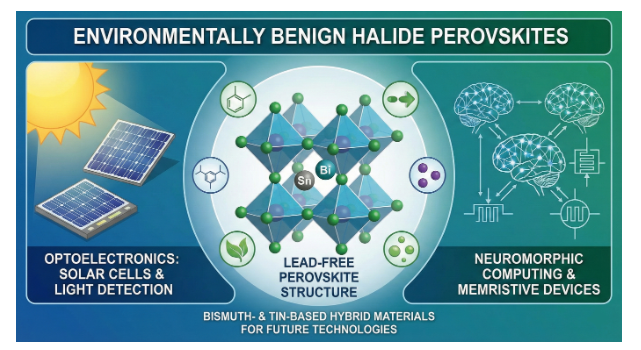
4. Lead-Free Halide Perovskites for Optoelectronics and Neuromorphic Computing — A major thrust of the group focuses on the design, synthesis, and photophysical characterization of environmentally benign bismuth- and tin-based hybrid halide perovskites. Funded programmes in this area span fundamental structure–property studies, light detection, photovoltaics, and emerging applications in neuromorphic computing and memristive devices. These projects are supported by DST-SERB, KSCSTE, DST Indo-ASEAN, and CSIR, and are carried out in close collaboration with AGH University of Kraków, Poland, and Osaka University, Japan.
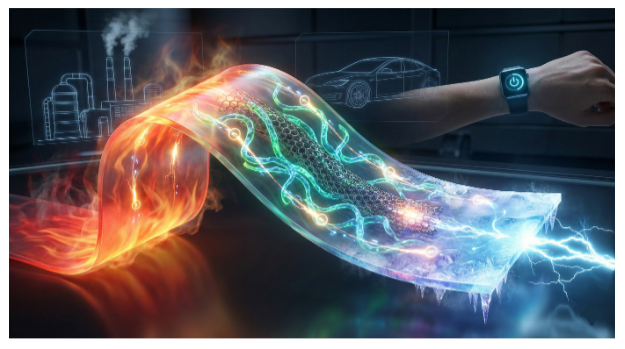
5. Organic and Hybrid Thermoelectric Materials for Energy Harvesting — A sustained research programme addresses the development of solution-processable conjugated polymer–carbon nanotube composites for flexible thermoelectric energy harvesting. The work spans molecular design, composite fabrication, device
engineering, and practical demonstration of waste heat recovery systems targeting industrial, automotive, and wearable applications.
- Research Area :Chemical Sciences & Technology Division (CSTD)