

Effect of Hyper-Cross-Linking on the Electrochromic Device Properties of Cross-Linkable Carbazole–Diphenylamine Derivatives (ACS Appl. Polym. Mater., 2023, 5, 6, 4170–4179; https://doi.org/10.1021/acsapm.3c00393)
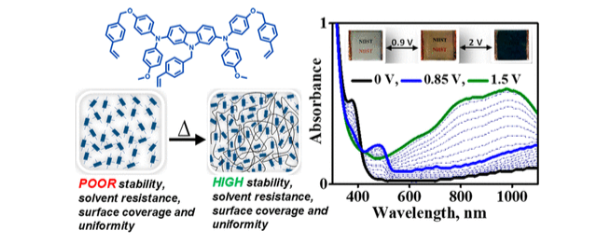
Cross-linkable triphenylamine-based molecules are promising organic electrochromic (EC) materials due to their low oxidation potentials, high charge mobility, and excellent electrochemical stability. Two donor–π–donor carbazole–diphenylamine derivatives, C-Sty2 and C-Sty3, containing two and three thermally cross-linkable styryl units, were investigated to understand the impact of cross-link density. Cross-linking produced uniform, solvent-resistant films with high thermal stability, while C-Sty3 formed hyper-cross-linked porous networks with enhanced conductivity and ion transport. Spectroelectrochemical studies revealed reversible color switching with improved optical contrast (78%) and high coloration efficiency (248 cm² C⁻¹). Reduced charge-transfer resistance highlights the critical role of hyper-cross-linking in improving electrochromic device performance and stability.
- Research Area :Chemical Sciences & Technology Division (CSTD)