


Technologies/Know-how
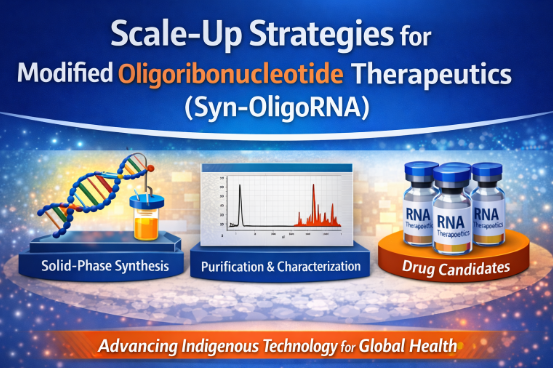
1. Scale-Up Synthetic Strategies for Short, Modified Oligoribo-nucleotide
Therapeutics (Syn-OligoRNA)
Indigenous development of oligoribonucleotide based drugs:
Oligoribonucleotide therapeutics represent a rapidly advancing frontier in personalized medicine and gene therapy. However, their widespread adoption is limited by high development costs and complex synthetic requirements.
At CSIR-NIIST, we have developed optimized and scalable laboratory protocols for the synthesis and purification of highly modified short oligoribonucleotides, enabling cost-effective indigenous production of oligoribonucleotide drug candidates.
This technology aims to:
Reduce dependence on expensive imports
Support affordable therapeutics for orphan and neglected diseases
Enable Indian industries to enter global oligonucleotide drug markets
Provide platform technologies for generic oligoribonucleotide development
2. Invisible Fluorescent Dyes and Pigments for Security Printing
The Process/product know-how for the making of invisible fluorescent dyes and pigments; Licensee: HueBright Colors Pvt. Ltd., Bangalore. Counterfeiting of currencies, documents, pharma products, and consumer goods is a global problem resulting in substantial economic losses to the nation and companies associated with it. Incorporating fluorescent markers, either through random distribution (fibers) or by printing (ink formulations), is among the most critical anti-counterfeiting measures used worldwide. These materials are currently imported at inflated costs from various countries, which is a threat to national security and results in forex depletion. In this context, the indigenous development of these materials and technologies that are difficult to duplicate is absolutely indispensable. CSIR-NIIST addressed this challenge by developing fluorescent molecules and pigments with appropriate fluorescence characteristics suitable for security printing. These products would help the existing players (public and private) reduce the expenses in terms of import cost and enable their competence in fluorescence-based security solutions.
3. Process Development of Specialty Chemicals
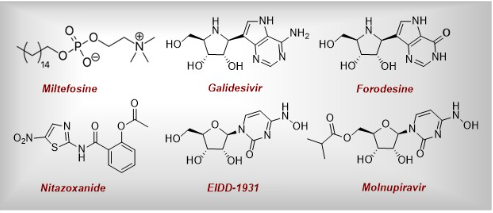
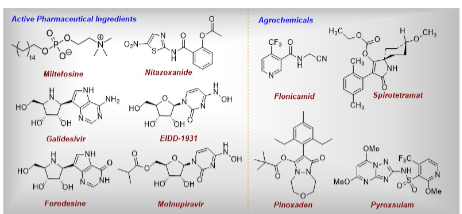
CSIR-NIIST is fortifying pharmaceutical self-reliance by delivering process development for a critical portfolio of Active Pharmaceutical Ingredients (APIs). By streamlining the synthesis of potent antivirals like Molnupiravir, EIDD-1931, and Galidesivir, alongside essential treatments for neglected diseases such as Miltefosine and Nitazoxanide, we are ensuring that life-saving medicine is more accessible and affordable. Our commitment to indigenous manufacturing excellence not only accelerates the response to emerging viral threats but also provides sustainable solutions for chronic and parasitic conditions, bridging the gap between advanced laboratory research and patient care.
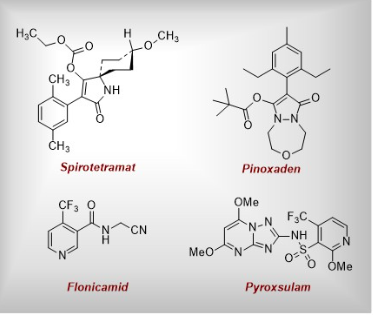
Under the CSIR Agromission, CSIR-NIIST has successfully advanced India’s agricultural resilience through the completion of innovative process development for key crop protection chemicals. Recognizing that agriculture is the backbone of the Indian economy contributing approximately 17% to the national GDP, these efforts focus on ensuring food security and stabilizing harvest-dependent livelihoods. The mission achieved significant technical milestones by developing cost-effective, novel processes for nationally important agrochemicals, primarily by utilizing indigenous raw materials and integrating efficient one-pot synthesis methods. These advancements have optimized manufacturing by reducing the number of process steps and eliminating tedious purification stages.
Highlights
1. New HTMs for Perovskite Solar Cells
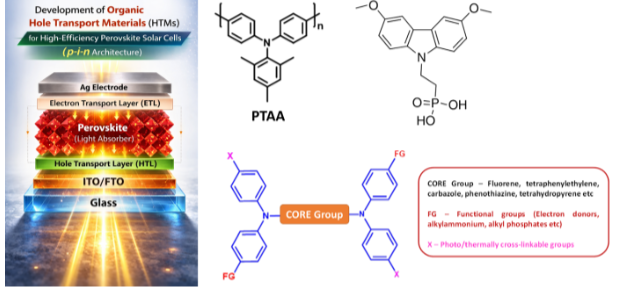
Organic hole transport materials (HTMs) are critical for achieving high-efficiency and stable p–i–n perovskite solar cells, enabling efficient charge extraction and device performance exceeding 20% power conversion efficiency. At CSIR-NIIST, cost- effective, solution-processable carbazole and triphenylamine-based HTMs are being developed to advance scalable and flexible perovskite photovoltaic technologies.
Unique Features:
Development of SAM and cross-linkable small-molecule HTMs for inverted
PSCs
Tunable energy levels for optimal band alignment and reduced recombination
High hole mobility with excellent film-forming and stability characteristics
Library of 50+ new HTMs enabling structure–property–performance
optimization
Solution-processable materials for flexible, large-area and low-temperature
PSC fabrication
Organic Electrochromic Materials & Devices
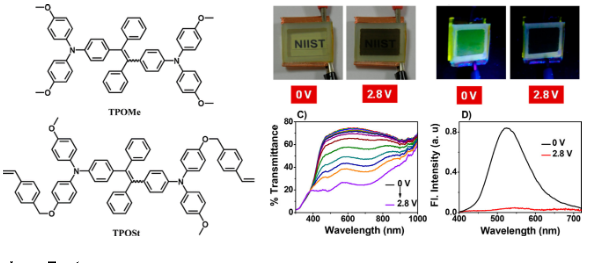
Organic electrochromic materials based on triphenylamine and carbazole derivatives offer promising solutions for smart windows and energy-efficient optoelectronic devices due to their tunable optical properties, low operating voltage, and solution processability. At CSIR-NIIST, cross-linkable small-molecule systems are being developed to achieve durable, high-performance electrochromic films and scalable large-area smart window technologies.
Unique Features:
Development of cross-linkable D–π–D organic electrochromic materials
Hyper-cross-linking enables stable, solvent-resistant, and uniform EC films
Enhanced coloration efficiency, optical contrast, and switching stability
Improved charge transport and ion diffusion via controlled film morphology
Scalable materials and device architectures for large-area smart window applications
Materials Chemistry
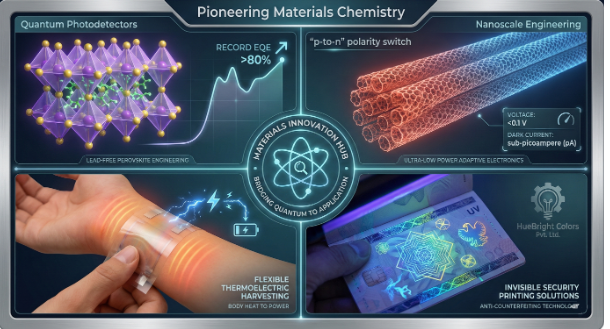
Achieved high external quantum efficiency among lead-free halide perovskite photodetectors through systematic organic cation engineering of bismuth iodide material.
Demonstrated ultra-low voltage operation (sub-0.1 V) in bismuth halide perovskite photodetectors with sub- picoampere dark currents, among the
lowest reported for this class of materials.
Established inter-octahedral halide–halide contact distance as a quantitative design parameter for predictive materials engineering in low-dimensional hybrid perovskites.
Demonstrated temperature-driven reversible p-to-n Seebeck polarity switching in single-walled carbon nanotube films without external voltage or polymer matrices, enabling autonomous adaptive thermoelectric operation.
Developed flexible thermoelectric generators based on conjugated polymer–carbon nanotube composites with demonstrated waste heat harvesting from curved and body-heat sources, with operational stability exceeding hundreds of hours.
Transferred process know-how for indigenous invisible fluorescent dyes and pigments for security printing to industry (HueBright Colors Pvt. Ltd., Bangalore), addressing a critical national need in anti-counterfeiting.
Natural Product Chemistry
Harnessing the natural wealth (plant/herbal/microbial) of the region to obtain novel biologically active compounds or leads for drug synthesis, exploring traditional systems of medicine including Ayurveda, Siddha and tribal medicine for lead structures and correlating/corroborating this wealth of knowledge with modern diagnostic chemical and biological testing methods. The natural products isolated from plants/microbial cultures are screened against several biological targets for antibacterial, antiviral, anti-inflammatory activities. This is done through interdisciplinary collaborations within the institute and also with several national laboratories and universities. In addition, we have a very good facility for in vivo screening of molecules with biological potential. The abundant natural products are synthetically modified for enhancement of biological activity. By utilizing the rich repository of phytomolecules, we are supporting the quality control/standardization of herbal raw materials and finished products for Ayurveda and herbal industry. The
scientific validation of herbal formulations, both classical and proprietary products are taken up in the institute. We have established a facility for herbal formulations with special focus on making galenical formulations of traditional medicines.
Unique Features:
Methodological explorations for effective evaluation and validation of
traditional wisdom
Exploration of the medicinal plants and microbes of the Western Ghats
Large repository of phytomolecules and analogues
Skill and expertise for isolation and characterization of natural products.
Semisynthetic modification of natural products
Multi-disciplinary and multi-institutional projects in CNS disorders and
infectious diseases
Development of sustainable and green methods for chemical synthesis
The quest for sustainable development in chemistry has tempted both organic chemists and environmental chemists to search for green and environmentally friendly methodologies. For sustainable development, the methodologies should
address three main factors: 1) reduced consumption of raw materials and energy, 2) maximum use of renewable resources and 3) minimal use of harmful chemicals. These new methods must be environment friendly with minimum of waste, with high efficiency and by utilizing processes with 100 % atom economy. There is an increasing demands for product safety and efficacy in the chemical industry and allied branches and this trend is evident in other branches of industry as well, due to increasing concerns for biodegradability of the products. The development of efficient methods to access complex molecules with multiple stereogenic centers has become a substantial challenge in both academic research and industrial applications. The growing importance of the chemical industry and other branches as part of Make in India initiatives of Government of India and the growing needs of effective, environmentally sound production methods, we are focusing developing sustainable methods by developing novel and efficient green routes for chemical
synthesis.
Unique Features:
Sustainable synthetic routes towards scaffolds for medicinal and materialinterests
Green chemistry routes for chemical intermediates, agrochemicals and advanced pharmaceutical ingredients
Organic photochemistry methodologies for green synthesis
Medicinal Chemistry and Chemical Biology
Medicinal plants have demonstrated their potential as a repository of bio-active molecules with promising therapeutic potential and represent an important pool for the identification of novel drug leads. To investigate new phytochemical entities (NPCEs), naturally occurring phytomolecules are subjected to semi-synthetic modification, transforming them into pharmacologically active NPCEs that serve as lead candidates for clinical translation. In-depth investigations underlying molecular mechanisms were ruled out using detailed in vitro and in silico approach. In the area
of chemical biology, an interdisciplinary team is investigating the intrinsic complexities of cell-surface glycans that impede to track the metabolic changes in cells. Metabolic glycan labelling (MGL) on the cell surfaces plays a pivotal role in cellular recognition like cell–cell communication and host–pathogen interactions etc. Moreover, fundamental structural changes have been observed in the course of many physiological processes which leads to the development of disease (e.g., cancer) progression.
Unique Features:
Semi-synthetic modification of bioactive natural products isolated from plants
New Phytochemical Entities (NPCEs) as advanced Hits / Leads towards anti-
cancer, anti-inflammatory, anti-diabetic and antiviral potential
Process Development Towards Chemical Entities
The team working on process development has successfully established different technologies for synthesizing active pharmaceutical ingredients (Nitazoxanide, Galidesivir, Molnupiravir and EIDD 1931), fluorescent dyes (red, blue, green and yellow) for security applications and agrochemicals (Flonicamid and spirotetramat). We focus on developing processes that utilize indigenous raw materials that are readily available. Another important factor that we take care of is the reduction in the number of process steps and also avoiding purification by column chromatography,
thereby decreasing the cost of production.
Unique Features:
Scalable processes utilizing easily available raw materials
Reduction in process steps and production cost
High yielding steps that doesn’t require expensive purifications
Engineering Lead-Free Halide Perovskites: From Molecular Design to Light
Harvesting
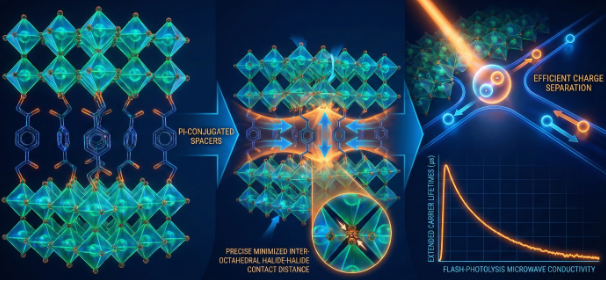
This research focuses on the rational design and synthesis of lead-free hybrid halide perovskites, where the judicious choice of organic spacer cations serves as the primary lever for tuning crystal structure, electronic dimensionality, and
photophysical properties. Through systematic variation of organic ammonium cations spanning polarizable aromatic and π-conjugated derivatives, clear structure–property correlations have been established linking octahedral connectivity, quantum and dielectric confinement, and charge-carrier dynamics. A key finding is that the inter- octahedral halide–halide contact distance is a master structural parameter whose precise control through organic cation engineering progressively enhances electronic coupling between the inorganic units, narrows the optical bandgap, and facilitates
exciton dissociation into free carriers. Flash-photolysis time-resolved microwave conductivity measurements directly probe photogenerated carrier dynamics, revealing that organic–inorganic heterojunction alignment dramatically extends
carrier lifetimes beyond benchmark lead halide perovskites. This molecular engineering framework, grounded in crystal chemistry and photophysics, provides actionable design rules for developing high-performance, environmentally benign
halide perovskite light absorbers.
Thermoelectric Materials: Waste Heat Harvesting and Self-Powered Sensing
This research investigates the thermoelectric properties of conjugated polymer–carbon nanotube composites and small-molecule organic semiconductors, with an emphasis on understanding how molecular structure governs charge
transport, doping efficiency, and the Seebeck coefficient. By pairing donor–acceptor conjugated polymers with single-walled carbon nanotubes, polymer-mediated non- covalent interactions are exploited to tune Fermi-level alignment and interfacial charge transfer through molecular doping, significantly enhancing electrical conductivity and power factor. Complementary studies on self-assembled small molecules demonstrate how subtle structural modifications in end-group acceptor strength modulate charge transport and doping efficiency, underscoring the critical role of molecular design in organic thermoelectric optimization. Extending this chemistry to ionic thermoelectric systems, temperature-driven reversible Seebeck polarity switching through ion thermodiffusion has been demonstrated, enabling autonomous adaptive operation. These solution-processable, mechanically flexible materials are directly applied to harvesting low-grade waste heat from industrial, automotive, and human body sources, while their large thermoelectric response and
room-temperature operability make them promising platforms for self-powered sensors in wearable and IoT applications.

Research Facilities
Major Equipments


Fabrication Facility


Formulation Facility


Other Equipments
-
Atomic force microscopy (NTEGRA NT0MDT)
-
Femtosecond pump probe spectrometer (CDP-2022i)
-
Nanosecond laser flash photolysis system (INDI-40-10-HG)
-
Picosecond time correlated single photon counting system (Delta Flex Detector PPD850)
-
Handheld Raman spectrometer (Mira DS Advanced)
-
yray Analyzer, ECIL.
-
UV-vis spectrophotometer (Shimadzu UV-2600)
-
UV-vis-NIR spectrophotometer (Perkin Elmer Lambda-950)
-
UV-vis-NIR Modular spectrometer (Ocean Optics DH-200-BAL)
-
Flame-Chem UV-vis spectrometer (Ocean Optics FLMS06876)
-
Spectrofluorimeter (Fluorolog 3 FL3-221)
-
Fluorescence spectrophotometer (HORIBA)
-
Modular spectrometer (NIR Quest 512-2.5 Ocean optics)
-
Circular dichroism spectropolarimeter (JASCO J810)
-
Optical microscope (Olympus 2000)
-
Optical polarizing and fluorescence microscope (Leica DM 2500P)
-
Dark field microscope (CYTOVIVA)
-
DNA/RNA synthesizer (H-6/H-8 VERO211 DNA Synth)
-
Dynamic light scattering (MALVERN Zetanano ZS-S)
-
HPLC recycling (LC-9260)
-
HPLC recycling preparative (LC9225 NEXT)
-
HPLC recycling preparative (LC 9101, JAI)
-
HPTLC (DESGAGA)
-
HPLC analytical (L.2000 HITACHI)
-
CHNS analyser (Elementar Analyser Vario Micro cube)
-
Parametric Analyser (4200A-SCS)
-
High energy mixer-mill (Labindia MM1100)
Recent Research
1. Phenothiazine-based TADF emitters with dual conformations for single-
molecule white OLEDs (Chem. Sci., 2026, 17, 1002-1015; DOI:
10.1039/D5SC04370K; Edge Article)
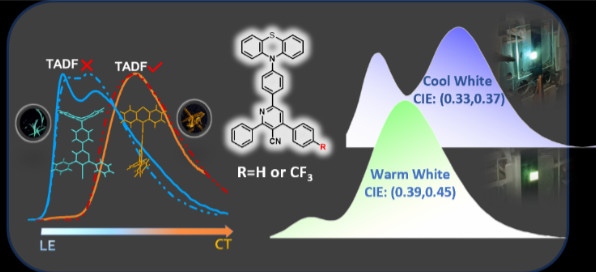
Phenothiazine-based donor–π–acceptor (D–π–A) emitters, NTPH and NTPCF, were developed as multifunctional materials exhibiting dual conformations with distinct photophysical properties. Structural studies reveal quasi-axial and quasi-equatorial conformers that enable tunable fluorescence and thermally activated delayed fluorescence (TADF). NTPCF shows green emission, while NTPH displays cyan emission and orange TADF arising from conformational switching with small singlet–triplet energy gaps. Mechanoresponsive behavior enables reversible color modulation, highlighting applications in sensing and anticounterfeiting. Solution- processed OLEDs based on NTPCF achieve luminance up to 8400 cd m⁻² and enable single-molecule white OLEDs, delivering both cool and warm white emission
through controlled doping strategies.
Accessing Isomers of Benzothienonaphthofurans via Regio Controlled Structural Fusion of Electrophilic Benzothiophenes with Naphthols (J. Org. Chem. 2025, 90, 16697–16710; DOI: 10.1021/acs.joc.5c01703)
Polycyclic aromatic compounds have found immense applications as speciality chemicals and in materials and devices. In…
Aggregation-Induced Enhancement of Deep-UV Response in Indoloindole -Based Organic Photodetectors (Adv. Optical Mater. 2025, e02481 ; DOI:10.1002/adom.20250248)
Organic photodetectors operating in the deep-ultraviolet region are crucial for environmental monitoring, biomedical…
Effect of Hyper-Cross-Linking on the Electrochromic Device Properties of Cross-Linkable Carbazole–Diphenylamine Derivatives (ACS Appl. Polym. Mater., 2023, 5, 6, 4170–4179; https://doi.org/10.1021/acsapm.3c00393)
Cross-linkable triphenylamine-based molecules are promising organic electrochromic (EC) materials due to their low…
Phenothiazine-based TADF emitters with dual conformations for single-molecule white OLEDs (Chem. Sci., 2026, 17, 1002-1015; DOI: 10.1039/D5SC04370K; Edge Article)
Phenothiazine-based donor–π–acceptor (D–π–A) emitters, NTPH and NTPCF, were developed as multifunctional materials…